

For roughly seventy years, Türkiye relied on the same seemingly magical formula for economic growth. It was fundamentally simple: move people from the countryside into cities, bring them into cycles of production and consumption, and let the economy grow.
The mechanism is straightforward. Every individual moving from low-productivity agriculture to more productive industry and services raises average productivity, even without any technological innovation. That person becomes both a producer and a consumer: someone works in textiles, buys a refrigerator with their wages, the refrigerator factory expands and hires more workers. A migrant worker moving to the city builds an informal dwelling, becomes a tenant, eventually obtains a loan if earnings improve, and starts paying a mortgage. The cycle feeds itself.
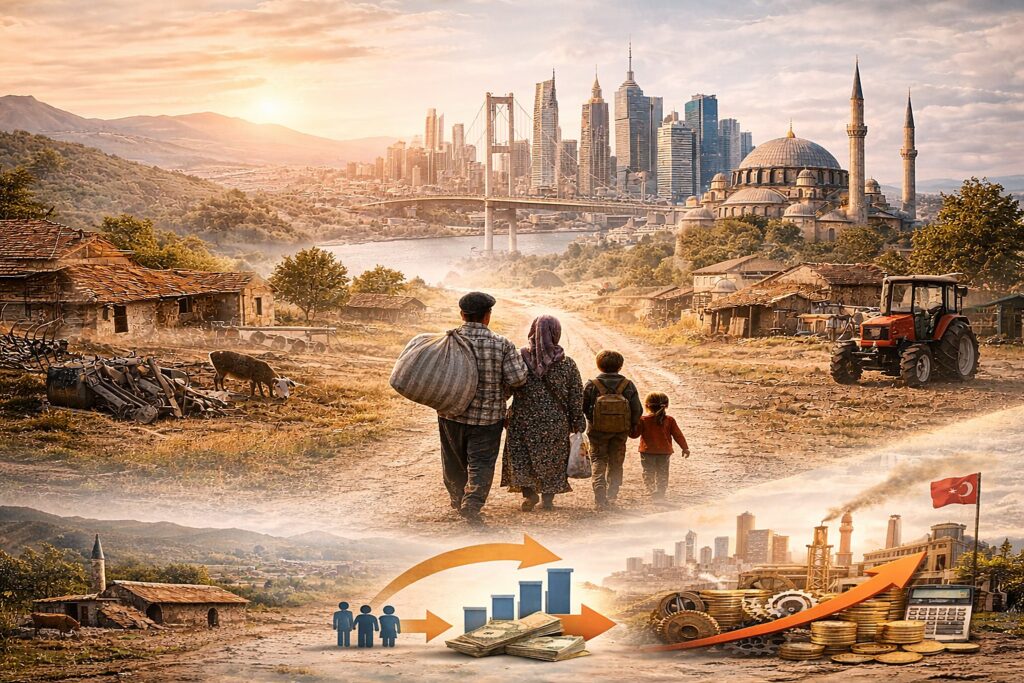
But this seemingly natural growth also contains an illusion. The productivity gain generated by moving labor between sectors is a one-time benefit. When urban sectors can no longer employ the population productively, or when the pool of people available to move from rural areas to cities is exhausted, the growth engine slows or stops altogether. That is what happened in Türkiye.
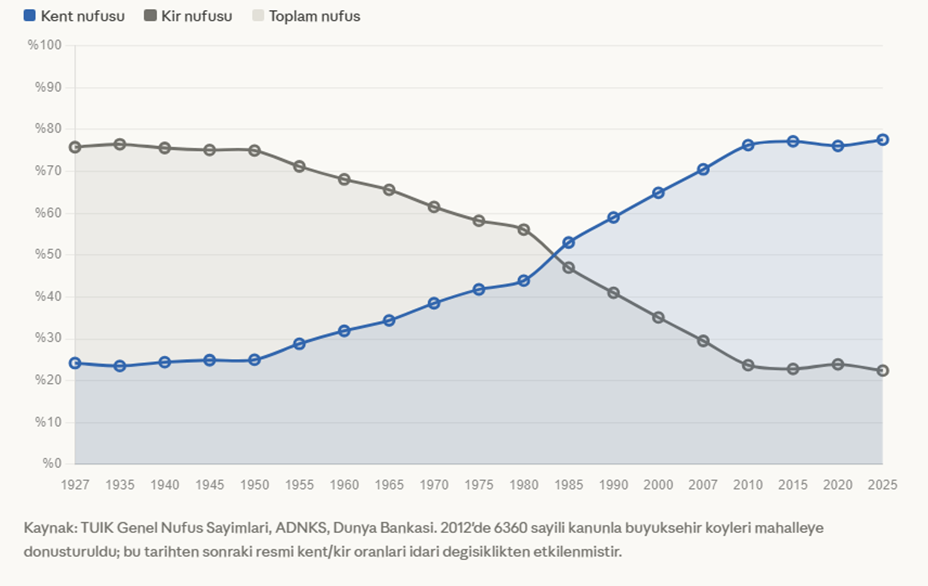
The numbers are striking. In 1927, 3.3 million people lived in cities and 10.3 million in villages. By 2025, the respective figures were 66.5 million and 5.5 million. When three-quarters of the population once lived in rural areas, three-quarters now live in urban areas. The proportions have been reversed. As the countryside sent its young people away, its remaining population aged and shrank. There are now very few people left to move to the cities. Birth rates have also fallen sharply amid the latest economic crisis.
The Formula’s Historical Background
During the early Republic (1923–1950), the state explicitly encouraged population growth. Large families were rewarded, abortion was prohibited, and fertility reached seven children per woman. But there was not yet a policy designed to accelerate urbanization. About 75 percent of the population remained in rural areas because the economy depended on agriculture and the state needed that labor. The people working the fields were quietly accumulating as the potential fuel for a future growth engine.
The turning point came in the 1950s. With agricultural mechanization supported by Marshall aid, tractor numbers rose from thousands to tens of thousands within a few years. This created a labor surplus in the countryside: the same output no longer required so many hands. At the same time, investment in roads under the Menderes government reduced the physical barriers between villages and cities. Rural push factors—mechanization, insufficient land, and fragmented inheritance—combined with urban pull factors such as industrial employment, infrastructure, and education.
Between 1950 and 1980, the urban population rose from 5.2 million to about 19.6 million: almost fourfold in thirty years. Migrants established belts of informal housing, or gecekondu settlements, around major cities. Those settlements themselves generated economic activity: demand for construction materials, informal employment networks, and new groups of consumers. Rather than simply being abandoned settlements, they served as laboratories of growth, as similar developments did in Brazil and elsewhere. Zoning amnesties subsequently turned them into centers of apartment construction and dense housing. What did it matter if there was not a square meter of parkland or other public amenities, if infrastructure was weak, and if the roads were muddy?
By 1985, the urban population had surpassed the rural population for the first time. Thereafter, the rural population began to decline in absolute terms as well. It had peaked at about 25 million in 1980 and fallen to 5.5 million by 2025.
It is difficult to say that governments actually managed urbanization. Rather, they changed the economic structure in ways that made migration inevitable, then responded reactively to the problems migration created. Laws granting amnesties to informal housing are the clearest example. By legitimizing the situation on the ground, they reduced social tensions while also feeding the urban rent-seeking economy.
The Price Paid: The Unraveling of the Countryside
Rural areas paid the heaviest price for this formula. They now face a double aging problem. First, fertility has been declining nationwide and the country as a whole is aging. People aged 65 and over accounted for 3.9 percent of the population in 1935, rising to 11.1 percent by 2025. Second, and more importantly, migration is selective. Working-age young people left first, while older people stayed behind. According to the Turkish Statistical Institute’s 2025 figures, of roughly 5.5 million residents of towns and villages, 885,000 were aged 0–14, 3.5 million were of working age, and about 1.2 million were aged 65 or over. The elderly thus represented around 22 percent of the rural population—twice the national average.
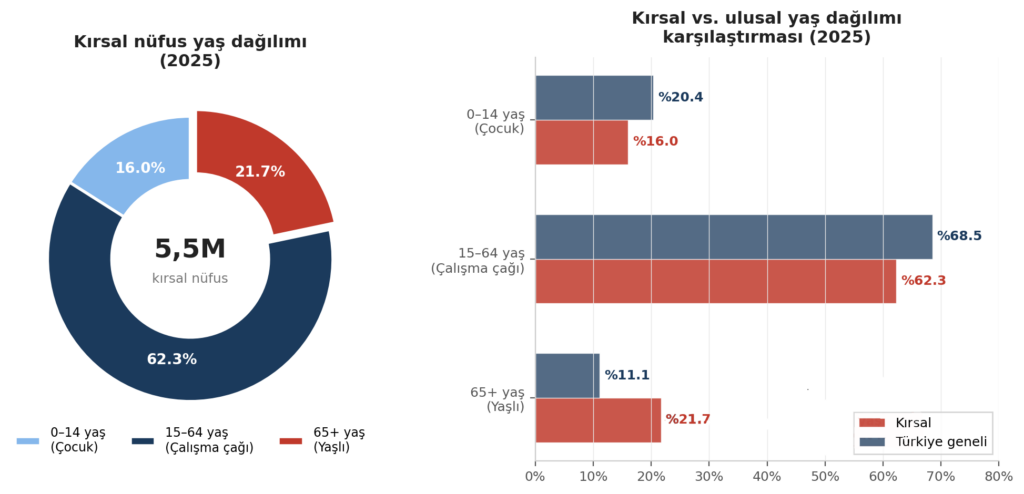
Age distribution of the rural population and national comparison (2025). Source: Turkish Statistical Institute (TÜİK), Address-Based Population Registration System (ADNKS).
According to TÜİK’s MAKS classification, 30 percent of the country’s population aged 65 and over live in locations classified as rural, although rural residents account for only 16.8 percent of the total population.
| Industrialization Through State Economic Enterprises in the Early Republic In the 1930s, as the Great Depression discredited liberal economic policies, the young Republic embraced the principle of etatism or state-led development. The private sector had little accumulated capital, and market mechanisms remained underdeveloped. The state became an industrial producer in its own right. The First Five-Year Industrial Plan was prepared in 1934. Sümerbank and Etibank were established. Sümerbank operated in textiles, leather, and ceramics; Etibank in mining and energy. Textile factories were built in Kayseri, Nazilli, and Ereğli; sugar factories in Alpullu and Eskişehir; a paper mill in İzmit; and iron-and-steel facilities in Karabük. These constituted Türkiye’s early industrial backbone. These state economic enterprises (SEEs, or KİTs) meant more than factories. Housing, hospitals, schools, and cinemas were built around them. Cities such as Karabük grew around an iron-and-steel plant. In effect, the state was building urban life and a modern way of living alongside industry. After the 1950s, the private sector gained prominence under the Democrat Party, but state enterprises remained. The State Planning Organization (DPT) was established in the 1960s, and five-year development plans were prepared. An import-substitution strategy was adopted, with high tariff barriers protecting domestic production. Major private industrial groups, including Koç, Sabancı, and Eczacıbaşı, also grew in this period, but largely behind protective walls. Industrialization was not fully exposed to global competition. By the late 1970s, state enterprises had become associated with overstaffing, low productivity, and political intervention. Loss-making enterprises were financed by the Treasury, feeding fiscal deficits and inflation. Import substitution had run into its limits, with foreign-exchange, external-debt, and energy crises converging. The economic turn of 1980 followed in this environment, as the global neoliberal wave gathered strength. |
| Edit: 23/03/2026 |
Neoliberal Industrialization: 1980 and the Unfinished Promise of Industrial Development
The year 1980 was, in fact, an attempt to change the country’s economic model. The January 24 Decisions aimed to move away from an inward-looking, import-substitution economy toward export-oriented, production-based growth. The early signs were promising. Textiles, automotive components, and white goods expanded. Exports rose from $2.9 billion in 1980 to $13 billion in 1990. Türkiye was genuinely beginning to build an industrial base.
This transformation is often described as a reform package arising from Türkiye’s own domestic dynamics, but the reality was more complicated. By the late 1970s, Türkiye was facing crises in foreign exchange, external debt, and energy. The IMF and World Bank became involved. In the Cold War balance of the time, Western powers could not easily accept Türkiye’s collapse: NATO’s southeastern flank was at stake, immediately after the Iranian Revolution and during the Soviet invasion of Afghanistan. Strong international interests supported the January 24 package. Özal certainly had a vision, but international circumstances and financing made that vision possible.
The military coup of September 12 provided the political framework for this transition. Unions were crushed, the left-wing opposition was suppressed, wages were held down, and the right to strike was effectively suspended. The move toward a cheap-labor model was not achieved through social consent but through repression. The fourfold increase in exports between 1980 and 1990 reflected not only exchange-rate adjustments but also a reduction in real wages of some 30–40 percent. The author’s argument is that the military regime made such an adjustment politically possible. The claim that CIA Turkey station chief Paul Henze told President Jimmy Carter, “Our boys did it,” has also become part of how the coup is remembered.
For better and worse, the economic transformation launched in 1980 thus combined international pressure and financing (from the IMF, the World Bank, and the Western alliance), an authoritarian political environment created by September 12, and technocratic leadership under Özal and his team.
Easy Money Beat Hard Money
As the transformation unfolded, two ways of making money competed. One was difficult: build a factory, produce, export, compete, and develop technology. The other was easy: buy land, obtain rezoning, build, and sell.
When rural-to-urban migration became the engine of growth, millions of new residents generated a surge in demand for housing. The demand was real and arose from genuine needs. Yet land and zoning rents became a central instrument of political patronage. Rezoning created value, and political networks distributed it. Even today, construction provides substantial employment with relatively low technological and skill requirements, readily absorbing unskilled workers. Construction therefore became a natural extension of the demographic-arbitrage model. The migrant from the countryside was simultaneously a customer demanding housing, a worker employed in construction, and a participant in the political legitimation of rent distribution.
Meanwhile, the production economy was gradually crowded out. Imagine an investor facing two choices. The first is to build a factory: five years of investment, uncertain returns, and global competition. The second is to buy land, secure rezoning, and earn a 300 percent return in two years. Which would a rational actor choose? In Türkiye, the same logic prevailed.
Capital systematically shifted from production toward rent-seeking, accelerating in the 2000s. TOKİ, initially established to support social housing and address housing needs, developed into a massive construction machine. Urban transformation projects generated enormous rents. Although the number of organized industrial zones grew and industrial firms filled them, much of the production remained in lower-value-added segments: textiles, basic automotive components, and food processing. I will leave the value added generated by the country’s many technology parks and R&D centers for another essay. The point is that neither organized industrial zones nor technology parks have entirely escaped the overwhelming force of construction and rent-seeking. The defense industry may be an exception, but it, too, relies on state support and a limited range of export-oriented products.
In the end, the economic transition that began amid the suffering caused by a military coup remained largely confined to industrialization centered on lower-value-added products. Rather than moving toward a model grounded in production, design, engineering, and innovation, Türkiye added a layer of rent extraction on top of its existing demographic-arbitrage model.
This is a familiar trap in the startup world: abandoning difficult but sustainable income when easy money appears. Short-term metrics can look wonderful. GDP grows, employment rises, and cities shine. But technological depth, sustained productivity gains, and global competitiveness may never develop.
Replacing the Missing Domestic Migrants with International Migrants
From the 2010s onward, Türkiye began to exhaust the easy growth gains generated by population movements. Urbanization passed 75 percent. Fertility fell below the replacement level in 2018 and reached 1.48 in 2024. Median age rose to 34.9.
As the growth contribution of internal migration diminished, international migration partly replaced it. Migration from Syria after 2011 was initially a response to a humanitarian crisis, but over time it also became part of the economic system. Millions entered the pool of informal labor. Labor-intensive sectors such as textiles, construction, and agriculture continued to draw on a supply of cheap labor. The same people also sustained demand for housing, food, and retail goods. It was, in some respects, a replication of the rural-to-urban migration formula of the 1950s.
But this patch has three major shortcomings. First, when cheap labor remains readily available, firms have little incentive to invest in innovation. Why buy robots when inexpensive workers are available? The article connects this dynamic to Türkiye’s difficulties in increasing income per capita measured in US dollars since 2013. Second, fertility among migrant populations is also declining, making any demographic contribution temporary. Third, the social costs of friction rise: public opposition to migration, downward pressure on wages, and strains on public services.
We Need a New Formula
The equation “more people = more growth” no longer works. Türkiye must grow by producing more output per person.
| Economists explain this transition through the Lewis model (labor transferring from countryside to city under conditions of surplus labor, bringing gains in marginal productivity until the surplus is exhausted) and the Fei–Ranis framework, which links the process to productivity in agriculture. Türkiye appears to have passed the Lewis turning point: the transfer of labor is largely complete. Growth now needs a different engine. The endogenous growth theories associated with Romer and Lucas offer explanations for the next stage, in which growth must increasingly come from human capital, innovation, and the diffusion of knowledge. Designing Türkiye’s future probably requires a hybrid approach. The remaining rural population of approximately 5.5 million and persistently low agricultural productivity mean we need a two-layer model: raise the productivity of the population that remains in rural areas while also developing an innovation-led urban economy. |
| Edit: 23/03/2026 |
Three possible directions seem available, but none is easy.
Productivity-led growth. Improve education quality, raise R&D investment, digitalize, and reform institutions. South Korea’s transformation in the 1990s is a useful comparison, although the institutional foundations it possessed then were very different from Türkiye’s present situation. This seems extraordinarily difficult, but perhaps our only genuine way forward.
Rediscovering the countryside. Make rural areas places where people can remain, rather than merely places they leave. Agricultural productivity, rural tourism, and infrastructure for remote work all matter. European smart-village models offer useful references, but Türkiye has major rural infrastructure gaps, especially in digital connectivity, health services, and education.
The aging economy. Rather than treating inevitable demographic aging solely as a crisis, recognize the potential for new sectors: care services, health technologies, retirement finance, and the silver economy. Japan and Germany provide reference points, but strong institutional capacity is essential. To do this successfully, we would first need capabilities resembling those of Japan or Germany.
All three approaches lead back to the same requirement: institutional capacity. And this brings us again to construction and rent-seeking. Transitioning to a production economy also means loosening the political-economic coalition organized around rents. Finding political leaders willing to do this voluntarily is difficult, because that very coalition helps parties come to power and remain there. Even when parties change, the influence of developers who finance politics informally and benefit from their political connections can persist.
South Korea managed such a transformation partly because its chaebols—the Korean counterparts of our conglomerates—were already oriented toward production, and the state pushed them into global competition. In Türkiye, by contrast, the center of gravity of capital has shifted from production toward real estate. Even the actors who ought to be building an economic transformation are playing a different game, while the state rewards entirely different activities through its policies.
The Foundations for Change
The economic-model shift of 1980 had several levers: supportive international conditions and external finance, a political and authoritarian framework that imposed the transformation, and leadership capable of implementing it. Türkiye today does not possess equivalent conditions for abandoning the rent-seeking economy—with all its institutions and habits—and moving decisively toward production based on productivity and value added.
Could an electoral democracy accomplish such a transformation? In theory, yes. In practice, however, the rent-seeking economy has a very broad electoral base. Millions work in construction. Rising house prices increase the perceived wealth of homeowners. When you propose ending the rent economy, you threaten their short-term interests. The gains from productivity-led growth, by contrast, take time. Education reform bears fruit over fifteen years. If your opponent promises a three-bedroom apartment while you promise improved education quality in fifteen years, electoral arithmetic works against you.
Türkiye’s polarized political structure makes agreement on reform even harder. Major transformations in South Korea and Ireland involved some form of national agreement about how the social costs would be shared. In Türkiye, every proposal is filtered through identity politics. The question “Who is doing it?” comes before “What is being done?”
A Window of Opportunity
Historically, transformations on this scale have often been triggered by major crises or powerful external pressures. The crisis of 2001 pushed Türkiye toward reform and reinforced the prospect of EU membership. South Korea’s transformation in 1997 followed the Asian financial crisis. Poland was pulled forward by the prospect of EU membership. In each case there was a crisis, an external incentive, or often both. It is genuinely difficult to identify cases in which transformations of this scale took place through elections alone without a major crisis.
As these lines were being written, the dominoes of global politics began to fall. On February 28, 2026, the United States and Israel launched coordinated airstrikes against Iran. Iran’s supreme leader, Khamenei, was killed. On March 2, the Revolutionary Guards announced the formal closure of the Strait of Hormuz. Tanker traffic reportedly fell by 97 percent, and Brent crude prices reportedly surged from around $65 before the war to as much as $126. Analysts described the disruption as potentially the largest energy crisis since the 1970s.
Iran did not close the strait to everyone. It reportedly allowed selective passage to vessels from Türkiye, India, Pakistan, and China. This highlights the renewed strategic value of Türkiye’s geographical and diplomatic position. Türkiye is both a NATO member and a country able to speak with Iran. Few actors could serve as intermediaries in the strait crisis, and Türkiye is among them. The United States sought coalition support from allies but received largely negative responses. Europe had opposed the war from the beginning, and relations among allies were already strained by the Trump administration’s tariff policies.
This crisis could affect Türkiye in opposite ways. As an energy importer, the country may face a wider current-account deficit, higher inflation, and further pressure on growth. At the same time, its strategic value may increase: a NATO member that can talk to Iran, an alternative energy corridor, and a country on which Europe depends for refugee management. This position could create external financing opportunities and bargaining power, as international circumstances did in 1980.
A possible political collapse or impeachment of Trump, should his calculations concerning the war with Iran fail, would not be merely a matter of American domestic politics. It could mark a symbolic turning point in the global wave of authoritarian populism, or even the beginning of a different political era. The Carnation Revolution in Portugal in 1974 was followed by democratic transitions in Spain and Greece; the fall of the Berlin Wall in 1989 triggered cascading transformations across Eastern Europe. Global political shifts are real, and their consequences can be rapid when their direction changes. If such a shift occurs, perhaps it will open an opportunity for Türkiye to move toward a new economic model.
But these windows are short-lived. The EU anchor that emerged after the 2001 crisis did not remain strong indefinitely; it began to weaken after 2005. The reforms following 1980 were overtaken by the rent-seeking economy within a few years. New Zealand implemented its 1984 reforms during a relatively short, intense period of opportunity. To pass through a window, one must be prepared: institutional design, a reform roadmap, and a societal coalition must be ready. If they do not exist before the window opens, it may close before a transformation can take place.
Two things therefore need to be ready: a reform roadmap that specifies what is to be done, and a societal coalition capable of demanding that transformation forcefully from political leaders.
Easy to say, difficult to do—as we all know.
No responses yet