

European Commission President Ursula von der Leyen, a member of Germany’s Christian Democratic Union, and Claudia Roth, a member of the German Green Party, represent two different political languages concerning Türkiye and, more broadly, Europe’s own identity. Today, von der Leyen stands for the institutional center of the European Union and its security-oriented, distancing, and even arguably colonizing reflexes. Years ago, by contrast, Roth used a coffee-and-milk metaphor to invite a more open and transformative understanding of relations between Türkiye and Europe. The difference between these approaches now points to a more fundamental divide over how Europe constitutes itself.
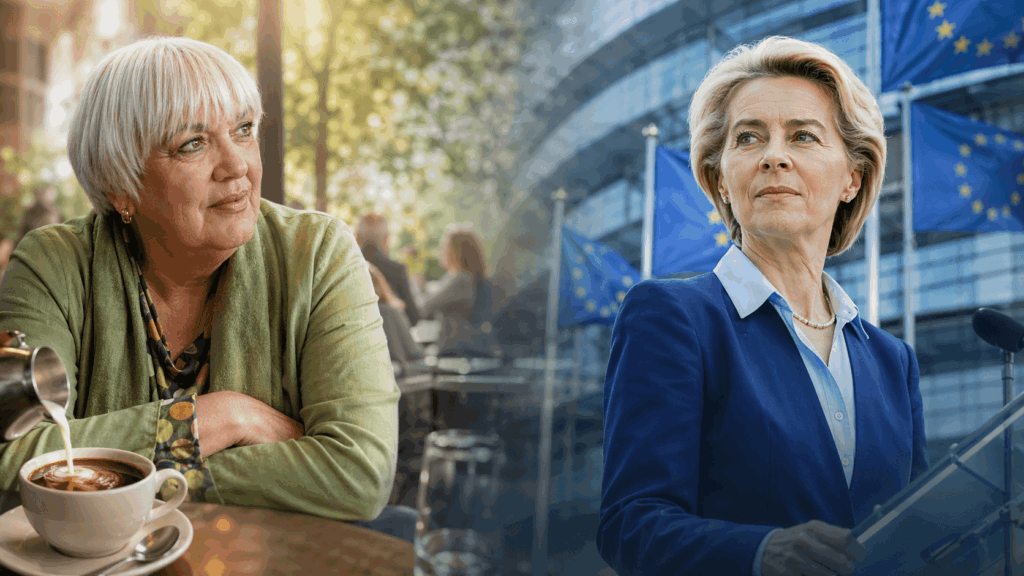
Roth’s metaphor captured this divide simply but powerfully. She criticized the idea that Türkiye should be like sugar in Europe’s tea: invisible, dissolved, no longer distinguishable, yet adding a little sweetness to the system. Instead, she proposed the image of milk in coffee. Milk does not merely add a small contribution from the outside; it mixes with the coffee, changes its color, transforms its taste, and produces a new whole. In the first image, Türkiye is useful but invisible. In the second, it is an equal and constitutive partner that transforms Europe even as it is transformed itself.
Von der Leyen’s mention of Türkiye alongside Russia and China in a negative context makes the contrast between these two approaches visible. The issue is more than an unfortunate choice of words or a diplomatic lapse. It reveals a reflex that exposes the political lens through which Europe views Türkiye and defines itself. Rather than being treated as a candidate country with a formal application for full membership, Türkiye is positioned as a peripheral actor with which Europe cooperates when necessary but never fully admits.
We all recognize this approach. For a long time, the European Union has spoken two languages at once in its relations with Türkiye. One is instrumental, acknowledging the need for Türkiye in security, migration, trade, energy, and regional stability. The other continually postpones a shared future, equal political belonging, and constitutive partnership. The relationship thus rests on calculations of usefulness whenever Türkiye is needed, rather than on genuine partnership. Proximity is desired, but full equality is not. Contributions are expected, but a role in shaping the whole is not shared. Stay at the door, do what is asked, do not cause too much trouble, and be satisfied with the recognition you receive.
Is there not a similar problem in Europe’s outlook toward other countries that it keeps within the prospect of membership and integration? They, too, are often treated not as equal partners with their own historical and political weight, but as peripheral spaces evaluated according to their compliance with norms set by the center. A language that initially appears open and inclusive may, in practice, establish a regime of hierarchical dependence. The center speaks; the periphery is invited to conform.
This is precisely where traces of a colonial outlook emerge. The problem is not only exclusionary language, but also the very form of what should be an inclusive understanding of belonging. Rather than viewing itself as a partnership open to change—a space for solidarity, fraternity, and cooperation—Europe positions itself as a fixed center that others must resemble in order to enter. It does not reject outsiders entirely; instead, it seeks to transform, discipline, and define their boundaries according to its own account of identity, an account that can come perilously close to racism rather than resting on shared values. Europe itself does not appear as a subject that must also change. This is an updated version of the classic colonial hierarchy.
This attitude is especially visible in the case of Türkiye. Millions of Turkish citizens and people of Turkish origin live in Europe. To continue speaking of Türkiye as something that affects Europe from the outside but is not part of it is therefore more than a diplomatic choice. It is a political language at odds with social reality. Moreover, at a time when the far right is gaining strength across Europe, such statements do not weaken the prejudices that ought to be challenged; they reinforce them. A language that treats Türkiye as an external entity to be managed rather than as an equal interlocutor distances itself not only from Ankara but also from Europeans of Turkish origin—and indeed from citizens at the margins of major European cities who fall outside this narrowly defined ideal of acceptable identity.
There is a deeper historical background to this impasse. Europe did not construct its modern political identity solely around shared internal values; it also defined itself against its various ‘others.’ Historically, Turkish and Russian figures were among those most frequently placed outside Europe’s imagined boundaries, held at a distance, and often portrayed as threats. Europe narrated itself not only through what it was, but also through what it was not. It is therefore unsurprising that Türkiye still appears as a boundary-marking figure in the rhetoric of certain European politicians. Yet that is precisely why this understanding now needs to be overcome. If Europe continues to define itself through exclusionary oppositions in the twenty-first century, it will weaken its claims to pluralism and democracy and struggle to manage differences peacefully within its own societies.
The real issue, then, is the vision of Europe behind von der Leyen’s statement. Will Europe define itself as a hierarchical, exclusionary center that seeks superiority, transforming others while refusing to transform itself? Or will it rethink itself as a plural political union that accepts mutual change? That is the difference between Roth’s coffee-and-milk Europe and von der Leyen’s border-drawing Europe, eager to govern those who do not resemble it. To make its future more peaceful, prosperous, and rich in possibilities, Europe must choose. What Türkiye has done or failed to do so far—and the choices it now faces—is, of course, the subject of another article.
No responses yet