

Do digital systems produce justice for women, or do they reproduce inequality faster and in a more “silent” way? This year, we need to read International Women’s Day from a different angle.
Hiring systems, automated screening tools, performance scores, shift scheduling software, and credit assessment models have become part of our lives. These systems may appear not to be “making decisions.” But in practice, they often determine who gets invited to an interview, who gets promoted, and who receives better pay.
Artificial intelligence and algorithms are not fair on their own. They usually learn from historical data. If women have been disadvantaged in hiring, promotion, or pay in the past, the system may learn this as “normal” and repeat it.
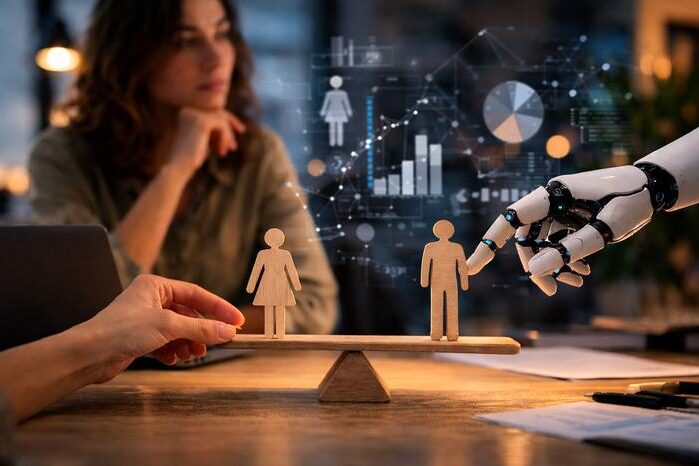
For example, the résumé of a woman who took a career break because of childcare may automatically be seen as “risky.” An employee using flexible work arrangements may be scored as “less committed.” In customer-facing roles, “fit” scores may unknowingly copy gender stereotypes. In this way, inequality no longer looks like a manager’s personal bias. It hides behind the phrase, “the system said so.”
We need to treat March 8 as a discussion about justice. The answer does not lie in the technology itself, but in how institutions and organizations govern that technology. AI does not bring equality on its own. Careless use automates inequality.
Systems should be tested regularly before and after deployment. It should be measured who they work against. It should be reported and corrected whether women are adequately represented in the data used, for whom the margin of error is higher, and whether the outcomes eliminate certain social and demographic groups more frequently.
Companies often implement these systems for speed and efficiency. But if you pursue only speed in hiring or performance evaluation, you lose justice. It must be clearly defined which decisions will not be automated and in which situations a human must step in. With the right to appeal and proper mechanisms, AI systems must be prevented from turning into walls that cannot be challenged.
Let’s talk about March 8 in terms of making technology work fairly for women. The real issue is who that software lifts up and who it pushes down invisibly.
Comments are closed