

Where will software companies sit in the value chain once generative AI becomes even more widespread? The transformation taking place in the RPA industry offers a good case for thinking through this question.
RPA quickly became the most visible tool of enterprise automation by promising to bridge fragmented systems and hand off repetitive tasks to bots.
But with GenAI, and especially agentic AI, the issue is no longer simply executing predefined steps. What matters now is understanding the objective, breaking the task into parts, interpreting exceptions, and creating flows across different systems. Automation has moved up from the level of “doing the assigned task” to the level of “designing how the task should be done.” Areas such as interpretation, contextual reading, and decision preparation are increasingly being concentrated in the hands of large language model platforms.
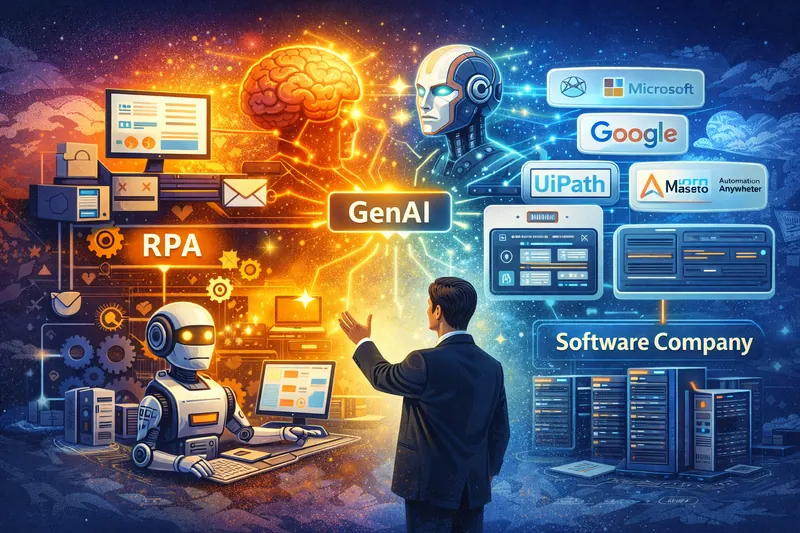
A software company that does not control the core customer experience and the reasoning layer will, over time, turn into a replaceable module running in the background. You may remain in the game technologically, but economically you get pushed downward.
The two biggest players in the RPA industry recognized this risk early. In 2025, UiPath launched Maestro, an orchestration layer that makes it possible to manage, supervise, and enforce compliance for different AI agents, whether developed in-house or by third parties, from a single control point. With founder-CEO Daniel Dines returning to take back the reins, the company focused on becoming an orchestration platform that bridges legacy systems and next-generation AI models.
Automation Anywhere moved in a similar direction. It developed a Process Reasoning Engine trained on 400 million automations on its platform, and by acquiring Aisera it gained the ability, through Mozart Orchestrator, to coordinate agents and automations across different platforms from a single layer.
Both moves reflect the same strategic reading. In the GenAI era, the defensible territory is not features but orchestration. Who manages the process? Who determines security, audit trails, compliance, and coordination across systems? Durable value accumulates less in the intelligence itself than in the layer that makes that intelligence operate reliably within an enterprise context.
As large language models become powerful enough to perform tasks directly, the need for a separate automation layer may decline. If the orchestration layer itself is offered directly by Microsoft, Google, or OpenAI, how durable will the position of RPA-origin companies in that layer really be?
In the coming period, the winners may not be those using the best LLM model. The greatest value may belong to those who make the enterprise architecture around the model indispensable.
In technology, the real struggle is often less about who invented the innovation than about who controls the gateway to the customer once that innovation becomes commonplace. The mobile telecom industry lost much of the high profitability it had grown accustomed to in exactly this way, as value shifted to handset manufacturers.
Comments are closed