

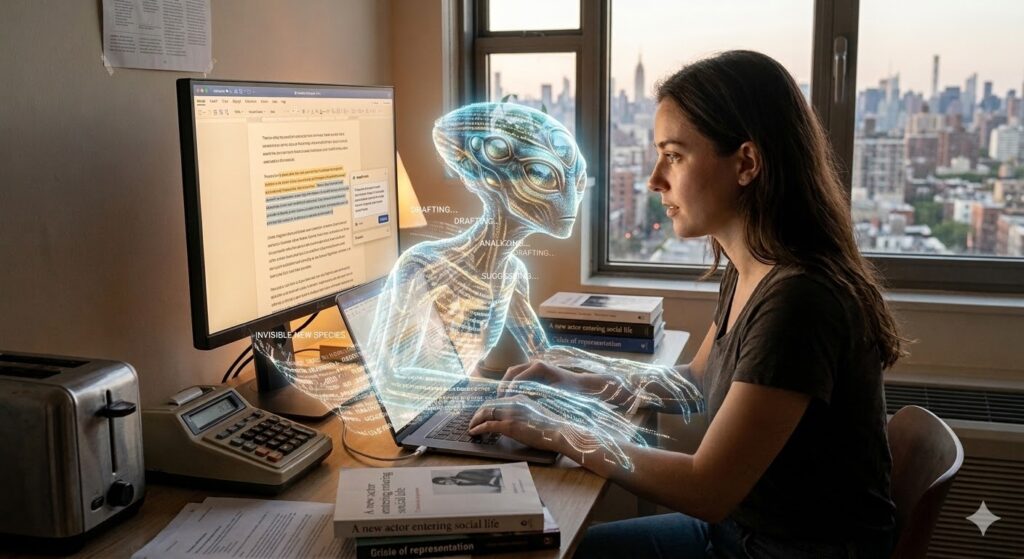
Our biggest misconception about artificial intelligence is that we still think of it as a machine. We need a stronger metaphor. Perhaps we should think of it as an invisible new species that has quietly joined the world. Like the aliens in Shyamalan’s Signs. We can’t see them directly. We only become aware of them through the traces they leave, the disturbances they create, a disquieting presence. GenAI is a bit like that today. It is mostly invisible, but its effects are everywhere.
We sense it in the overly smooth tone of an email, in the flawless flow of a student’s assignment, in the sterile clarity of a presentation. There is no body. Just a voice, an interface, a stream. For a long time, humanity imagined aliens arriving with metal bodies, red eyes, a thunderous invasion. But what arrived this time constructs sentences, makes suggestions, drafts documents, persuades. It enters not by breaking down the door, but by offering to help.
This is not a new calculator or a kitchen appliance. The question is not about getting used to new technology. It is about a new actor entering social life. GenAI is not only accelerating work. It is changing the structure of communication, the meaning of labor, the source of expertise, and the boundaries of accountability. We used to assume that behind every text stood a writer, behind every report an expert, behind every policy memo a manager. Now an invisible collaborator has entered the picture. Who wrote it, who thought it through, who framed it? These questions are becoming harder to answer.
GenAI is transforming not jobs first, but social roles. The value of a white-collar worker no longer comes from processing information alone. The real value is becoming the ability to filter outputs, place them in context, identify risks, and take responsibility. Education must change too. Schools can no longer function purely as institutions that transfer knowledge, because access to knowledge has become cheap. When anyone can write, what matters is personally knowing what can be defended.
The greatest risk this new species creates — even before unemployment — is a crisis of representation. Society will produce more and more text, reports, summaries. But behind all these multiplying outputs there will be less thinking, less accountability. Productivity rises while responsibility thins. Institutions appear smarter while actually just speaking faster.
The picture is not entirely dark. GenAI is giving many people new capabilities: reducing language barriers, offering smaller players the advantages of scale, speeding up creative production. The problem lies less in the technology itself than in how we integrate it into society. Will it make decisions, or prepare them? Will it replace human judgment, or strengthen it? Will it increase transparency, or evaporate accountability?
How will we learn to live alongside this new quasi-species? We cannot figure that out by demonizing it or by being enchanted by it. It speaks like us, but it is not human. It knows a great deal, but has no lived experience. It is fast, but has no moral intuition. Stop looking for aliens in the sky. They are already inside our sentences.
Comments are closed